Friday, August 13, 2010

A Guy Named Barrow-- Believed Published for the 1st Time Since 1934

Here's one you don't see every day. During the desperate years of the Depression, outlaws like Bonnie & Clyde captivated the public's imagination. To many, B&C were wild and unpredictable killers-- but to some, it seems they served an unlikely role as anti establishment heroes. In 1934, a woman named Myrtle J. Potter wrote a poem which was published in a Dallas newspaper. For nearly 7 decades, Myrtle's poem lay dormant within the archives of The Dallas Public Library.

9 years ago, in scouring these archives for Bonnie & Clyde materials-- Shelley Mitchell helped uncover this gem of a B&C memory while researching with Jimmy Ray Gillman. Now Shelley's been most kind, in offering the Myrtle Potter poem for all to enjoy here on The B&CHB. Many thanks to Shelley, for sharing this unique piece of 1930's commentary with us. It's believed, this is the 1st time Myrtle's poem has been published in any truly public medium since 1934. So please enjoy this colorful offering, including it's wonderful Depression Age language and slang.

To me, this is a most interesting commentary on Clyde Barrow, in that some of Myrtle's expressions almost seem sympathetic to him-- while it's ending appears to suggest a solution in dealing with Clyde, which had an eerily true ring to it. *Note the last 2 stanzas of Myrtle's poem and the date below it-- and then consider, the events which occurred but just one month later. As always-- I welcome your comments.

Guy Named Barrow

Thar's a big drive on, and it's nationwide
For a guy named Barrow, and his first name is Clyde
He's a fresh young squirt from the Longhorn State
And makin' his rounds in a Ford V- eight

He's been a-bustin' inter banks, and abreakin' outer jails
Ascarin' the wimmin, and arobbin' the males
And he killed two cops, the goshderned fool
Now he's gone and shot himself a constibule

For a long time he's been acuttin' such capers
And agittin' his name inter all the blamed papers
Till Ma down in Austin got her dander up
And decided to ketch this onery pup

So she ups and puts a price on his head
Says she wants Clyde Barrow alive or dead
Now the cops are some worried, fer all they know
That's he's as void of a conscience as hell is of snow

And, as no smart cop wants to jine the saints
They don't look where he is, they just look where he ain't
And these fellers don't deserve no blame
If I was a cop I'd do the same

For they had Barrow once, locked him tight in a cell
And Ross let him out, so what the hell?
Now it's up to somebody to ketch him agin
So let that thar Pardon Board go fetch him in

If this was a rule, thar ain't no doubt
They'd be a derned sight carefuller who they let out
Now, up in the country where I come from
They'd make short work of this son of a gun

They'd jist set on the fence sorta innocent like
Till this pole cat come afriskin' down the pike
And as he passed by, they'd just cut loose
And fill both his eyes with terbaccer juice

Myrtle J. Potter
April 16, 1934
Dallas, Texas

Tuesday, August 10, 2010

In the Bonnie & Clyde Edition of Clue-- It Was Aunt Pat, With the Matches in the Back Yard

It's often asked, what happened to Bonnie Parker's personal effects-- which may have survived after her death?? It's long been rumored, a member of the Parker family had destroyed Bonnie's belongings-- as the family couldn't stand the pain of reflecting upon Bonnie's death, while being reminded of her. Unfortunately the bottom line of this story "is" true-- however as it turns out, the fate of Bonnie's belongings apparently may have had less to do with sentimentality, and more to do with a personal dispute. As the question of Bonnie's belongings continues to surface, I feel it's important to set the record straight-- and report what I've been told is the truth regarding that most unfortunate event.

Recently I mentioned, one of Emma Parker's sisters played a key role in Bonnie & Clyde History. While revealing a B&C Poll answer concerning Emma being notified of Bonnie's death, I quoted from a news article-- which detailed the presence of both Emma's sister Lelia along with Edith Parker, when Emma took that fateful phone call on May 23rd, 1934 at the Parker residence. As it seems so many within the story of Bonnie & Clyde had nick names, Lelia was better known as Pat. Pat's married name was Plummer. Billie Parker writes of aunt Pat, along with a plethora of Parker and Krause relatives within the family history she compiled. With many thanks to a Parker family source-- I've learned it was Pat Plummer who destroyed Bonnie's things.

Although the more traditional and sentimental explanation still exists, concerning the destruction of Bonnie's chattels which I'm sure many would prefer to hold onto-- apparently the truth is, Billie had given Bonnie's belongings to aunt Pat for safe keeping. They were then housed in some sort of storage shed on Pat's property. But as sometimes happens within the best of families, some disagreement ensued between Billie and aunt Pat. Based on this falling out, apparently one day Pat thought to torch that storage shed-- and did. As such, Bonnie's belongings were no more.

It would be remarkable, to be able to view the personal effects of Bonnie Parker and learn from them. But seemingly as a result of this rift between Billie and aunt Pat, that glorious pent up desire became impossible long ago. As it's not clear when this incendiary decision of Pat Plummer's occurred, nor are the specifics known concerning Pat's disagreement with Billie-- it's conceivable their dispute could have followed the lines of the original story told. Perhaps some within the family were indeed having trouble dealing with Bonnie's death, based on some issue concerning her belongings. Could it be, that Billie wanted to keep these memories where others didn't?? Thus they were placed out of sight and out of mind?? Then aunt Pat puts a fiery end to this controversy through her actions?? Or perhaps, this was just as simple as some bad blood between Billie and her aunt Pat-- which led to a vengeful act against Billie, and thus Bonnie's things were destroyed?? My understanding is, the later could more be the case, but without clarifying info we may never know for sure.

I as others have searched for years, for any trace of the love letters exchanged between Bonnie Parker and Clyde Barrow while Clyde was imprisoned. A number of these love letters were transcribed in Fugitives-- and provide great insight into the young lovers, as they expressed their feelings for one another. To my knowledge, none of Bonnie & Clyde's many love letters have ever been found. At this point I wonder-- whether Bonnie and Clyde's romantic exchanges didn't go up in smoke, along with Bonnie's other effects in aunt Pat's back yard?!? At least now we know, what's said to be the true story and also who was responsible for the destruction of Bonnie Parker's personal items. Emma's younger sister, Lelia Krause (Pat Plummer) lived between the years of 1893 and 1965. The photo shown, is purely for illustrative purposes. As always, I welcome your comments.

Sunday, August 8, 2010

Bonnie and Clyde Q&A-- Is Bonnie's Sister Billie Jean Still Alive??

Billie Jean Parker was born December 16th, 1912 and passed away on May 13th, 1993-- at the age of 80. One of her 80 years, was spent at the Alderson Federal Prison Camp in West Virginia-- serving her debt to society, for her role in aiding Bonnie & Clyde. Billie died of COPD. It's said that her heart just gave out. Interestingly, she asked not to be embalmed.

Billie was married 3 times-- to Fred Mace, Troy Frazier and A. B. (Arthur Bourland) Moon. Although public records don't confirm this, the best info I have-- is that Billie Jean is buried at Cedar Creek Lake, Texas. Her children Jackie and Buddy are buried at Crown Hill Cemetery in Dallas-- near their aunt Bonnie, grandmother Emma and uncle Buster.

I for one, feel we owe a great deal of thanks to Billie Jean-- for the legacy of B&C knowledge she has left us. Although said to be a bit rambunctious while she was young, from accounts I know of and the personal reflections of those who knew her-- Billie Jean Parker was a loyal family member, loving sister and upstanding person. As often said, the eyes are the windows to the soul. This picture of Billie Jean originally taken with her mother Emma-- is my favorite Billie Jean photo.

Many thanks for a most timely question.


Thursday, August 5, 2010

Bonnie, Clyde and Me-- The Foreword & Introduction-- Billie's Intent, Revelations & Depression Age Realities


A quite interesting aspect of Billie Jean Parker Moon's previously unseen manuscript-- is it's unique foreword & introduction. In it's unfinished form, it's a bit difficult to envision-- how what exists of Billie's book would have been revised from it's 2nd draft, to become a more unified and complete work. As such the foreword is identified, but what would likely be the introduction-- who's words paint a vivid and most passionate picture of Depression Age life, just appears-- sandwiched in between the foreword and Billie's 1st Bonnie and Clyde account of the Sowers ambush.

Be it incomplete, Billie's manuscript is uniquely important for what it is-- a most "remarkable" and welcomed addition to Bonnie & Clyde History. I thought you might enjoy reading this insightful foreword with it's revealing look into Billie, and snapshot of the times in which she and Bonnie and Clyde lived. Within these colorfully patterned words, are melded a vivid portrayal of Depression Age life-- along with Clint Kelley's impressions of Billie, and Billie's reasoning for wanting to publish a book on Bonnie and Clyde. I have searched without success so far for Mr. Kelley-- as I would like very much if possible, to speak with him concerning Billie's effort of which he was involved.

What I believe are Kelley's descriptions of the Depression Years, jump off the page so nicely at times-- that I wonder if like Billie, he too was a product of those tough and hellish years?? Based on the tenor of expressions used, I feel that may have been the case. I as many of you, have read numerous accounts of the Depression. But I've never read an expression of the 1930's quite like this. This dynamically phrased introduction, seems to bring the strained realities of those hardened times front and center.

You'll note one current politically non-correct term, which within the years of The Great Depression I would suppose appropriate-- whereas now, this racially charged description would be considered decidedly out of bounds. I find it intriguing, this term was still used in the 1970's in writing of the 1930's. However the "furor" over this word, wouldn't erupt fully until the 1990's. Don't shoot the messenger-- but instead enjoy all of what I feel is a telling look at Billie's motivation for wanting to write her book-- plus a unique insight into the times of Bonnie & Clyde. Of particular note are Billie's feelings concerning the Methvins, and her admission that she might have made a similar deal concerning the ambush-- should she have been in a position to save Bonnie. Wow!! As usual, accounts from Billie's manuscript are re-told verbatim. I believe this time, I've only corrected a spelling error or 2 along the way-- where they obviously needed to be. In the words of Clint and Billie Jean--


"Billie Jean Parker Moon is a rare lady who has mastered the art of forgiving and, in some cases, forgetting. She bears no anomosity toward anyone, even though her life and her family were irrevocably shattered during the three bullet-spattered years her sister Bonnie rode the outlaw trail with Clyde Barrow. With hindsight born in the 40 years since those fateful days, Billie has sorted out her feelings and has attempted to sort out the fact and fiction surrounding the famous duo. In this book, she is not attempting to vindicate Bonnie Parker and Clyde Barrow. She is trying, simply, to set the record straight. "I want to tell their side of the story as they told it to me during those years when it actually was occurring," she said."

"Bonnie Parker was never in any trouble at all until she met Clyde Barrow. But when the trouble started, she stood by him and rode out the storms. In the process, since Billie was extremely close to her only sister, she found herself drawn into situations on which the law frowned. In one case, Billie was arrested and charged with the slayings of two motorcycle patrolmen, killed in a brief battle with elements of the Barrow gang. She wasn't there, as later was proven to the satisfaction of officials, but her arrest and confinement would have left scars on a lesser person. Eventually, she was sentenced to serve a year in prison as an accessory to Bonnie and Clyde."

"W. D. Jones, a member of the Barrow gang for several months, did exactly what Clyde Barrow told him to do if he ever was arrested. Jones gave police a statement saying Bonnie and Clyde had forced him to join the gang and keep him with them through use of force. Jones also said in the statement Billie was a member of the gang. While it was true that she frequently rode with Bonnie and Clyde and helped nurse them after shootings and assorted accidents, she never actually participated in any crime perpetrated by any member of the gang."

"In retrospect, Billie says she can't really hate even the Methvins, who "sold out" Bonnie and Clyde in 1934 and set up the ambush that led to their bloody deaths. "Old man Methvin was simply trying to save his son (gang member Henry Methvin)," Billie said. "I can understand his making a deal with the law to help kill Bonnie and Clyde in return for charges being dropped against Henry. If I could have made the same deal to save Bonnie, I might have done it."

"The only man she really hates is a former friend whom she refuses to identify. He was the man who drove the family car on a windy night in Grapevine when Bonnie and Clyde almost were killed as they attempted to meet with their families. "That man sold them out for a used car and a few dollars, she said. "His only motive was profit. He didn't have a son to save like Mr. Methvin did." Billie's close association with Bonnie and Clyde during their period on the run has given her valuable insights to their lives and valuable details of their triumphs and failures. As a "non-member" of the gang, she is the only person associated closely with the facts who can afford, emotionally and legally, to disclose details."

"Writing a book with Billie has proven difficult because of this attitude she has built up over the intervening 40 years. She has, in some cases, refused to name people involved with the gang, even though those names are well-known and already have been associated publicly with Bonnie and Clyde. "I know how I would feel if one of those people wrote a book and used my name," she said. "I've stayed out of the public limelight since Bonnie and Clyde were killed and I wouldn't appreciate someone stirring all that up again."

"While some people would attempt to capitalize on such a relationship, Billie has not. Ironically, her neighbors in a quiet section of Mesquite, Texas, where she resides, have no idea she is the sister of Bonnie Parker. And that's the way Billie wants to keep it. "My only interest is telling people some of the things Bonnie tried to tell them before she died." Billie said. "The kids led a rough life and they wouldn't want anyone-- then or now-- to follow in their footsteps."

Clint Kelley
January 1975
Dallas, Texas

"The world was a miserable, wretched place to be in the 1930's. It was a time when death lurked around every street corner-- death which could be as slow as starvation or as quick as a whistling machinegun bullet. It was a time when normally strong men took the easy way out and suicides became as common as sunrise. It was a time when bedraggled mothers worried because their spindle-legged children were sporting painfully bloated stomachs, heartbreaking symptoms of malnutrition. And it was a time when the pall of despair lay more heavily over the countryside than the air pollution and stench of more modern times."

"It was not a time for decision-making. Everyone and everything-- including the immediate future-- was in doubt. But it was a period when decisions were forced.. when they were wrung from the hearts and souls of every person by sheer force of poverty and circumstance. Texas, like the rest of the world, was in turmoil. While a handful of men were getting rich in the massive oil boom, the average citizen was hard-scrabbling a niggardly existence in which the staff of life was being whittled shorter with every skimpy meal. Farmers and laborers worked 18 hours a day for short wages, hoping and praying times would get better and the dinner table eventually would be laden with something besides the beans and cornbread which stood between them and death."

"The 1930's were tough times-- for everyone, everywhere."

Billie Parker Moon's manuscript is © 2010 The Bonnie & Clyde History Blog by A. Winston Woodward-- with all rights reserved. Many thanks
.

Saturday, July 31, 2010

The July Bonnie & Clyde Polls-- No More Pencils, No More Books--

In honor of Summer and to note the Alice Cooper classic, School's Out-- no books were needed this time around regarding the B&C Polls. In the past, I've used many varied sources for poll questions. I'm not sure, but this may be one of the only times I've formed all 8 monthly questions-- without much use of a B&C book. As such 1 of July's poll answers was available through the written page, but uniquely-- this time all the answers were available via the Internet. Newspaper clippings scattered here and there, as well as B&C historical photos and websites such as Frank Ballinger's Bonnie and Clyde's Hideout seemed to work wonderfully well-- in creating challenging questions. So here we go-- with July's B&C Internet based B&C Polls potpourri.

You needed to locate an image of Bonnie's marriage license, to know who married Miss Bonnie Parker and Roy Glenn Thornton on September 25th, 1926. Certified copies can be obtained from the Dallas County Clerks Office. But if you look around, the Internet does afford opportunities to view an image of this most interesting document. I included every name listed on Bonnie & Roy's marriage certificate as choices, including R. E. Foster Minister of the Gospel-- who married them. Texas marriage license #114552 was applied for on September 24th, 1926-- with Minister Foster performing the marriage a day later on September 25th. Thus contrary to many published accounts-- Bonnie was still 15 when she married Roy Thornton.

63527 was Clyde's prison number from Huntsville concerning his (7) 2 year sentences totaling 14 years cumulatively. Clyde's Division of Investigation U.S. Department of Justice fingerprint card detailed this info. It was Ralph Fults who used the alias of Jack Sherman, well before W. D. Jones became famous for it. Fults used this alias when caught with Bonnie at Kaufman, Texas (many say Maybank) on April 18th, 1932. Fults took the fall for this early Barrow Gang bungled caper, while Bonnie although held-- was eventually no-billed and released.

Henry Barrow advertised a number of products openly as noted by photographs of his Star filling station. However the photo above seems to say it all, concerning the most prominently displayed billboard for Coca Cola. To me, this is the rarer of the photos showing Henry outside his West Dallas gas station. It seems even in the '30's-- things went better with Coke. It took a head first dive into the B&C news articles for the next query-- where it was Blanche Barrow, who reportedly revealed the possibility of loot buried at Dexfield Park. An unidentified article states-- "Blanche shortly after her capture, said the gang had hidden some of the bank loot in the woods somewhere near where they had camped." Based on this published report, apparently many searched for the reported cache of Barrow Gang money. Another article which told of this rumor, said the hidden loot may have amounted to around $4000. ($60,000. in today's money). Another Bonnie & Clyde tale. I wonder if this one was true??

It was a reporter from The Dallas Times Herald, who first reached Emma Parker by phone to tell her of Bonnie's death. In a revealing news article published at the time-- it was noted before telling Emma Parker of her daughter's demise, the reporter asked Emma whether she was alone?? To which Emma responded that her daughter in law Edith was present with her. Emma was then told Bonnie & Clyde had been killed. "Where did it happen??" Emma reportedly asked. To which the reporter said "Near Gibson Louisiana-- do you have any relatives there??" "No-- but you must be kidding me" Emma replied. "There is no mistake, both of them were killed" the reporter stated. At that point, the phone was heard to drop and a woman screamed. Another woman picked up the phone to state "Mrs. Parker has fainted. Why didn't you come out here and tell her face to face??"-- "I believe you are a damn liar." After Billie's Attorney Fred Harris had inquired of the truth and called Emma to confirm the worst, Emma's sister Lelia Plummer called the Dallas Times Herald press room to apologize for her cross remark.

Mrs. Plummer (Aunt Pat, as known to the Parker children)-- would later become responsible for a most dramatic decision and action concerning B&C History. More on Aunt Pat another time. So both Edith Parker (Buster's wife) and Emma's sister Pat Plummer were said to be present, when Emma was notified of Bonnie's death by a Dallas Times Herald reporter.


And speaking of Emma, only one person apparently knew it was Emma Parker-- who uttered the blistering quote concerning the ambush. That quote-- was written of within a news article entitled, Mother of Gun-Moll Enraged at Officers and 'Double Crosser'.

And finally the question where I can accept 2 answers as being correct. Within the May 14th, 1934 report, written by SAC Whitley of New Orleans to Bureau of Investigation Director J. Edgar Hoover as reported to Whitley by Bureau Agent Lester Kindell-- it's noted "if extradition of Methvin is demanded by other states for crimes, that Henderson Jordan will go to Governor Allen of Louisiana and explain the facts." Oscar Kelly Allen was the Governor of Louisiana at the time of Bonnie & Clyde, and likely only Governor Allen would possess the power to block the extradition of Henry Methvin from Louisiana. Never the less, as it was Henderson Jordan who expressed the desire to approach the Governor if need be-- I can accept either Sheriff Jordan or Governor O. K. Allen as correct answers. Perhaps it will be revealed someday, why some you wouldn't suppose-- were willing to fight so hard to protect Henry Methvin and why?? Alas another B&C secret, not yet ready to surface.

So there you have it-- another installment in the ongoing and hopefully always challenging B&C Polls. As August is here-- look for new B&C polls to be posted soon. And as always "many thanks"-- for your participation in the polls.

Saturday, July 24, 2010

Who Introduced Bonnie & Clyde??-- The Answer Appears to be Found "All in the Family"

The event of Bonnie Parker & Clyde Barrow meeting for the first time, has been told and re-told-- but seemingly from the same source material-- Fugitives.

As related by Emma Parker within Fugitives, the 1934 Parker and Barrow account-- "I had never heard Clyde Barrow's name and didn't dream that such a boy existed until January, 1930. Bonnie, still out of work after the closing of Marco's Cafe, had gone to stay with a girl friend in West Dallas. This girl had broken her arm, and Bonnie went to help with the work. Clyde's folks lived near, and here it was Clyde came and meet my daughter. It all came about so simply, as such momentous and life-changing things often do. Clyde dropped by this girl's house. Bonnie was there, and they met. That was the beginning."

However ultimately it would take some 79 years, along with the release of a long secret file-- for the mystery woman with the broken arm to be known with any certainty, who by her own admission introduced Bonnie and Clyde. As with a number of known or suspected individuals, who's names were seemingly "changed to protect the innocent" within this family memoir-- this person's identity too was shielded. However in reality, one needn't look far-- to discover the truth concerning this close family relation.

Dallas FBI File 26-4114, is a treasure trove of little known or previously publicly unknown Bonnie and Clyde info-- documented from the time of B&C. Such is the case, concerning the key individual within this mystery. On January 5th 1934, renown B&C and Dillinger Bureau of Investigation Agent Charles Winstead filed a report-- of which both handwritten and transcribed versions exist within the Dallas FBI files. This 5 page memo signed by Winstead, had to do with interviews conducted by himself and a peace officer named Carroll in Gladewater, Texas. Many pieces of valuable information were garnered from the more talkative female interviewed (who it's said was against officers generally)-- however much less was learned from the less talkative male.

Some of this knowledge revealed by the woman questioned, included her clarifications concerning the identities and relationships of various Parker and Barrow family members-- the correct ages of B&C-- the story of Clyde's previous love affair with Grace-- information concerning Frank Clause and Clyde Barrow, along with revealing Frank's employer-- the identity of Bonnie's husband Roy Thornton and prison term he was serving-- info on Billie Parker Mace, her age and the deaths of her children-- the fact that this woman's husband who was also interviewed, is questioned regularly by Dallas lawmen concerning B&C-- along with the revelation that B&C won't come near this couple, due to her husband's dislike for B&C's mode of living-- and B&C's concern for their safety, as alcohol was often present. But paramount to a long pondered B&C mystery, was the revelation that it was she-- who introduced Bonnie to Clyde.

If you don't already know, or haven't guessed by now, these were interviews conducted with Buster Parker and his wife Edith Clay Parker. In writing of his interview with Edith Parker, Agent Winstead wrote-- "She said she introduced Bonnie to Clyde." So apparently the woman with the broken arm, who helped to facilitate a fateful love at first sight-- was none other than Emma's daughter in law-- Edith Ray Parker. According to Billie Parker's well documented family history, Edith Ray Clay married Buster in 1929. So I suppose she could be described as a friend to protect her identity-- but in reality as of 1930, Edith was Bonnie's sister in law.

By the way-- these were the same interviews which led to poignant statements by Buster Parker. Buster said he knew Clyde was going to get Bonnie killed, and would rather know Bonnie in a penitentiary than with Clyde. Buster then promised, if ever he should learn of Clyde's whereabouts while separated from Bonnie-- he would give that information to 2 named lawmen. It seems that like a number of others both inside and outside the families near the end-- Buster was willing to turn on Clyde, in his case unabashedly-- in order to save his beloved sister Bonnie.

From time to time, some seem critical of the Dallas FBI files on Bonnie & Clyde, but I never understand why??-- nor do I feel those impressions logically justified. Perhaps for some, it's just a matter of coming to terms with contrary views of heroes-- from one side of this history or another?? But as info like this concerning Edith and Buster Parker is priceless to Bonnie & Clyde History-- I for one am grateful for so much additional B&C knowledge now being available, after so many decades shrouded in darkness. As I see it, an objective view of history should necessarily include all the good, bad and ugly-- and the more info to help discern the truth, the better. Based on new B&C knowledge being revealed, I remain more & more intrigued by accounts within Fugitives-- now being proven as other than told. As always, I welcome your comments.

Wednesday, July 14, 2010

Billie's Compassion for Bonnie & Clyde

As we are winding down now concerning materials remaining within Billie's mid '70's manuscript (and as I've been bouncing around anyway)-- I've decided to skip to the end, of what is known of Billie's unpublished writings. Remaining are a good intro and quite unique description of Depression realities, along with additional insights from Billie Jean-- which I'll post stand alone. Throughout Billie's unfinished book, I feel there's considerable compassion evident within Billie's descriptions and memories of Bonnie & Clyde-- which may not have been so obvious, within writings revealed in this series so far. But as you'll soon see, these expressions of compassion from Billie Jean are prominent-- within her thoughts and recollections of her beloved sister and the man Bonnie loved. Thus it's time to quote Billie's manuscript again--

"Bonnie has been painted as a gun-toting gangster who smoked cigars. That is not true. She never smoked cigars and, before her death, tried to make it clear to the public the image was wrong. It would sadden her today if she knew she never was successful and that most people still believe she was addicted to cigars. Clyde also has been much abused by the press and the police. He admitted to us many times that he had robbed places and killed people. But he was accused of many things he denied to the family. Why, if it wasn't the truth, would he deny these things when he admitted so much more was true."

"My purpose is to tell what I know to be the truth about Bonnie Parker and Clyde Barrow. I grew up with and loved her. And many times I rode with them after the law was hot on their tails. I know the heartache they felt at not being able to live normal lives with their families. I know the caution they had to use-- even to the point of not calling each other by name-- in order to avoid the bloody end that eventually was theirs. I know the misery they endured in the wind swept woods as they tried to sleep and stand watch at the same time."


"I sat up many nights at the campsites, standing a watch in which the silence of the woods magnified every sound to terrifying proportions. I know the feeling of panic which came to them when a sudden sound would send Clyde scrambling for his guns and Bonnie running toward the car. When they are called cold-blooded killers, nobody bothers to mention they were kids, barely into their 20's. Nobody seems to care that when Bonnie died on that deserted Louisiana road while trying to help a friend, she was only 24-years-old and so homesick she would have abandoned the back roads if she could have."


"Nobody seems to realize, or care, that Bonnie never was in any trouble until Clyde Barrow appeared in West Dallas. And nobody seems to realize that Clyde got involved in a set of circumstances from which he could not return. They were kids forced by times and life to take the road they took. By the time they realized what was happening, it was too late to turn back. Their suicide pact is clear evidence they knew what eventually would happen to them. They preferred death at their own hands to death in the Texas Penitentary's electric chair."


"Instead, Bonnie Parker and Clyde Barrow were cut to tiny pieces by a combination of police and bounty hunters shooting from ambush. The kids were dead before they even could touch one of their guns. And, ironically, their last thought was for a friend in trouble. When they pulled off that Louisiana road and into the ambush, they were pulling over to help Henry Methvin's father change a blown out tire on his old truck. I don't guess they ever knew Methvin had sold them out to the posse. At least, I hope they never realized that."

Billie can be seen leaning on Clyde with his arm firmly wrapped around her in the picture above. In a number of ways, this family photo said to have been taken the day before the Sowers ambush-- seems to speak for itself. Next to the closeness between Clyde and Billie, I've always thought the sorrowful resignation in the expression of a worn looking Emma Parker-- to be the most remarkable element of this photo. To me, The Barrows were perhaps better at putting on a good face for the camera than the Parkers-- where the reality of their situation, seemed more apparent within their expressions. Through Billie's admissions, we know now Bonnie felt responsibility for Emma's morass of sorrow. With her mother's arm around her, perhaps that too is evident-- in the expression of Bonnie Parker.

There's still more to learn from Billie's manuscript-- so please look for additional insights, from this wonderful and personal collection of Bonnie & Clyde remembrances. Billie Parker Moon's manuscript as recounted in all forms-- is © 2010 The B&CHB by A. W. Woodward. As always I welcome your comments.


Friday, July 9, 2010

"That Damn Clyde Barrow"

Today a quick, and wonderfully funny story from Billie Parker Moon's manuscript. This one has to do with Billie's son Buddy Mace. As it was told by Billie--
"There was the time Clyde gave my 4-year-old son Buddy a sackful of quarters. There must have been eight or ten dollars in quarters in that sack. The next day, Buddy was handspringing proud of his new found wealth. He told his grandmother that he would pay the newspaper boy. Back then, we paid 25 cents a week for the daily paper."
"When the paperboy came, Buddy proudly handed him a quarter and demanded a receipt. The paperboy was in a kidding mood that day. He solemnly told Buddy that the quarter was a fake... no good. Buddy looked at him and I was afraid he was about to say he had gotten the money from Clyde and his Aunt Bonnie. Instead, he took the quarter back and strolled into the house. He walked up to me and said, "Mammy, that damn Clyde Barrow done stuck me with a whole mess of fake quarters."

"When Buddy died a short time later, Bonnie and Clyde were in Dallas and had just bought him a Shetland pony. The poor little guy never got to see the animal."

As a point of reference, the inflation conversion from 1933 to today is about 15 to 1.  So $8 to $10 of quarters then, would equate to $120 or $150 today. A pretty good haul for a youngster. There's more to come from Billie's unpublished book, so stayed tuned for more Billie insights-- exclusively here on The B&CHB. Excerpts from Billie Parker Moon's manuscript are © 2010 The B&CHB by A. W. Woodward. I hope all are enjoying these rare B&C revelations.

Thursday, July 8, 2010

Bonnie and Clyde Q&A-- Was Clyde's Sexuality Ambiguous?

Short and sweet-- If you believe in the movie version of Bonnie and Clyde, w/Clyde's sexuality seemingly depicted as being ambiguous, based on callous & unsubstantiated rumors proliferated in modern times by John Toland and others after him-- then yes. If you believe in Bonnie & Clyde "History"-- as supported by those who knew Clyde best, and in realizing there's apparently no concrete evidence to support such a claim-- then no is the correct answer.

I suppose those who would ask over and over whether Clyde was a homosexual, could be the same folks who might ask-- what fruit B&C were eating when killed?? It looked to be a pear in the movie-- but in reality, there's no evidence there was ever a piece of fruit present.

I've got to look up the article I found a couple of years back, which outlines the rise and fall of male heterosexual expressions of affection common in the early 20th century-- which may explain the Clyde and Ray Hamilton hand holding photo. That singular picture, is the only real portrayal I can see-- to question Clyde's sexual focus. Criminal camaraderie may also explain this photo. Blanche's comment that W. D. didn't like to sleep alone, could also be considered within this debate-- however there's nothing else to back up any nefarious inference, concerning this Blanche revelation.

Almost every day, The B&CHB receives multiple key entry questions concerning this subject. For those here for that purpose-- please look up and read the August 8th, 2009 post entitled "Sordid Rumors and Innuendos Exposed"-- "Please"-- Por Favor, Bitte, Tevreden, Svp,
Nожалуйста, παρακαλώ,  Per Favore!!

There's no verifiable evidence to support a claim of Clyde Barrow being gay-- "none"--
ningunos, никакие, nenhuns, keine, nessun, κανένας, aucun, niets!! As such, this great challenge remains open-- if anyone knows of evidence to support sordid claims regarding Bonnie or Clyde-- I'm sure all would welcome hearing of this info.

At some point, there will be a follow up to the Sordid Rumor's and Innuendos piece.
Research is underway to identify the sources used by John Toland (apparently earlier published works)-- although this source info too, appears dubious.

Tuesday, July 6, 2010

Billie Tells of Wellington and Beyond

In her unpublished manuscript, Billie Parker Moon relates her recollections from a number of key Bonnie & Clyde events she was there to witness. Always of keen interest within the history of Bonnie & Clyde, is any account of The Barrow Gang's time after Wellington. The gang's foray into Fort Smith, Ark. involving Bonnie's traumatic injuries from the Wellington incident, and the gang's dealing with them-- seem to elicit elements of compassion, even from the most hardened B&C detractor.

I was going to separate Fort Smith from McKinney within publishing these reports on Billie's remembrances-- but decided instead to combine them for continuity. Oddly, the singular detail of Billie traveling back to Dallas by bus-- seemingly has some B&C scholars in a tizzy. When I first read this account to others, unanimously-- it would be said "it was a train". Well surely Billie knew the difference between a bus and a train, and which conveyance she traveled on. As mentioned, some B&C facts may have to be re-worked, with Billie's accounts now known. Billie Jean's recollections of the McKinney, Texas incident are particularly detailed and interesting-- as well as her revealing a kind person's perjury under oath, in protecting Billie concerning the aid she rendered Bonnie at Fort Smith. Also of note, is a possible conflict between Blanche's account after Fort Smith and Billie's account of the same time period. Interestingly, this 2 week period specifically noted by Billie-- is a time where little seems known within this history.

So here we go, with more of Billie Parker Moon's eyewitness accounts from Bonnie & Clyde History.

"In the summer of 1933, the kids were driving fast over a back road near Wellington, Texas. As they topped a hill, Clyde could feel the car slipping along the road. "Hang onto your hats," he yelled. "This is it." The car went out of control and careened through some guard rails into a ditch. The car caught on fire, burning Clyde superficially. But Bonnie was hurt badly. She suffered bad burns on her legs-- burns which left her permanently unable to straighten her right leg or walk without a heartbreaking limp."

"As always when they were in trouble, they turned to their families-- the only people in the world they knew would never betray them. Clyde drove to Dallas from Fort Smith, Arkansas, in a stolen Ford to pick me up. They had rented two cottages near Fort Smith and were attempting in the best way possible to take care of Bonnie. When I arrived, I was greeted by Buck and his wife, and by W. D. Jones. Bonnie was in a coma and didn't know I was there."

"The daughter of the man who owned the tourist court was a nurse. She provided a doctor friend of hers and began intensive treatment to get Bonnie's festering leg to heal. Neither the motel owner, his daughter or the doctor knew at the time who we were. Later, however, in a moment of human kindness I shall never forget, the nurse refused from a witness stand to identify me as the woman who had helped Bonnie through this period."

"Cold-blooded, impassionate killers? When Bonnie regained consciousness, her first thoughts weren't for herself. They were for me. She insisted to Clyde that I be returned to Dallas immediately, before more trouble started and before I became irrevocably involved. The next two weeks we spent wandering back roads enroute to Texas... stopping where necessary to rub ointments on Bonnie's wounds and camping out at night. They finally got me to Sherman, Texas, and put me on a bus back to Dallas."

"Bonnie always was concerned with keeping me safe. I was with them one afternoon when they were low on money-- as they usually were-- and low on gasoline for the Ford Clyde invariably drove. We stopped at a churchyard at McKinney and Clyde got out of the car, telling me to keep it running. He strolled off in the direction of town. With the gasoline situation low, I made a mistake. I turned off the engine while we were waiting for Clyde to return. Bonnie still was in pain from the Wellington burns and she was sitting in the back of the car. When Clyde returned, he threw a sack of change on the seat from a grocery store robbery he had just pulled. He was mad-- raging-- about the fact the car wasn't running. It was the only time I ever can remember his losing his temper with me."

"As he started the car, it lurched and the wheels became stuck in the mud. A woman and her son happened by in their car and Clyde offered them $20 to pull us out. He cut a barbed wire fence nearby and used the wire as a chain, wrapped around the bumpers of our Ford and the other car. As soon as we were out of the mud, he clipped the wires and roared off. He couldn't have paid the woman $20. Our only money was the three or four dollars in change he had taken from the grocery store."

"While the car was in the mud, people began to materialize from no where. Bonnie was afraid for me and told me to get out of the car and mingle with the crowd. "Pretend you don't know us," she said. "You aren't involved in this robbery." I looked into the back seat where she was lying. She looked so afraid and sick, there was no way I was going to leave her like that. She looked so pathetic, I wouldn't have left her if the whole country had been full of laws. Those were the bad moments... moments where everything could have ended at once. But there were good times. Times when we got together and for an hour or two, the kids were able to forget they were wanted fugatives."

On that note, there's more to come from Billie's manuscript-- so please stay tuned. Excerpts from Billie Parker Moon's manuscript, in part or in their entirety-- are © 2010 The B&CHB by A. W. Woodward. As always, I welcome your comments.

Thursday, July 1, 2010

"But when the air cleared, I counted at least 25 cops- city, county and state" Billie Parker

The story of The Sowers Ambush has been told and re-told over the years-- but never quite like this. Within her unpublished manuscript, Billie Parker Moon spends considerable time speaking of Sowers. And rightfully so-- for Billie had a unique advantage in relaying her account of this dramatic Bonnie & Clyde event. Not only was she present to witness this November 1933 Texas ambush attempt 1st hand (including being shot at)-- but as an insider with an intimate closeness to Bonnie & Clyde, Billie was privy to many unique details as told by the outlaws after this waylay occurred. Thus Billie's able to fill in gaps previously untold, and provide a "gripping" account from ground zero. I'll say this-- based on Billie's recollections of this story, as Ricky Ricardo would say-- it seems some who've recounted differing versions of this event over the years, may have some esplanin' to do-- with Billie's account now known.

The identification of Sowers as the ambush location, has always been a bit of a misnomer-- as Sowers both today as in yesteryear was an unincorporated community. Those who live in this community today, find themselves within the city limits of Irving, Texas. As such, Billie never identifies Sowers by name. Rather she calls this location Grapevine, for the community which was nearby. But there's no mistaking Billie's description of this incident, as being the same episode we've come to know as The Sowers Ambush. In November of '33, the actual location of the ambush was the crossroads of Texas Hwy 10 and Esters Road. Today, with an updated highway system, this spot would be the intersection of Texas Hwy 183 and Esters Road.

So without further delay-- see how many new pieces of information you can find within Billie's account of Sowers. There were just 4 lawmen present for the ambush, as wheeled out for photos by the Dallas Sheriff's Office, right??-- or 6 lawmen as reported by the newspapers?? Not according to Billie-- not by a long shot.

Also pay close attention to Billie's description of the Sowers informant. Although she's reluctant to name "him" by name-- by process of elimination within Billie's account of who was present, along with her explanation of this man's role that evening-- to me Billie leaves little doubt concerning both the identity of the Sower's informant, and her hatred for this individual. This man's reported participation with the families that November evening, has been confirmed many times by those present over the years.. and within Billie's account, now reconfirmed.  You'll also learn in fabulous detail, what happened to B&C after the ambush. So here we go, and as always-- I relate these wonderful Billie accounts verbatim. Bonnie & Clyde's quotes are emboldened.


"The Ford rolled slowly down the road and then faltered, as if the driver momentarily was unsure of himself and the situation. The car's light blinked on and off in a prearranged signal which had become familiar through long use. The flashing lights were answered in kind from a second car parked further down the road. Bonnie Parker and Clyde Barrow had returned home for another visit with their families. The scene was familiar to all of us. We had met them before in out-of-the-way places around the Dallas area. Clyde had telephoned earlier that evening to arrange the Grapevine meeting. As Bonnie's only sister, I took our mother along and we were joined by Clyde's mother, sister and younger brother. A family friend drove the car we were in."

"The Ford, reassured by the exchange of signals, gathered speed as it closed the distance between it and our waiting car. The Ford moved in front of our car and the headlights illuminated the front seat. As usual, Clyde was at the wheel with Bonnie close beside him. The kids had made it back in one piece-- something on which we never could depend. A grin which had been building on Clyde's face turned to a grimmace as the Ford slowly rolled to a stop. A flash of red light erupted from a bar ditch alongside the road. It was accompanied by a popping noise which sounded for all the world to me like firecrackers at a Fourth of July celebration. It was the beginning of a gun battle which Bonnie would say later was "the closest we ever came to dying."

"It took a few moments for me to realize the ditch alongside the road was filled to the brim with cops of all shapes, sizes and services. The headlights of our car still were trained on the Ford and, pushed by an instinct I didn't know existed, I reached across the front seat and killed the lights, shrouding the Ford in darkness. Flickering gunfire outlined the ditch in flashes of red and the miniature thunder from the guns rapidly became deafening inside our car. Clyde, always an excellent driver even in the worst of situations, shoved the Ford into gear and sped down the road in a storm of gravel and gunfire."

"Bonnie and Clyde escaped that night but not without considerable loss. Clyde had been hit two or three times in his legs and a bullet lodged in one of Bonnie's knees. They almost bled to death before reaching Salisaw, Oklahoma, and the safety offered them at the home of the brother of Pretty Boy Floyd. It was later that we realized the "family friend" who drove the car for us that night had told police of the planned meeting. He sold them out for a used car and a few dollars lawmen were offering for the end of Bonnie and Clyde. They had been betrayed by a man they called friend. A similar betrayal on a lonely road near Gibsland, Louisiana, two years later would cost them their lives."

"There was no glamor in the lives of those kids. Just like there was no glamor that long ago night in Grapevine. Bonnie told me later she had a premonition about the meeting. "When we pulled onto that road, something didn't look right," she said. Clyde slowed the car and gave the signal. When it was returned from our car, Clyde told her "It'll be alright, honey. We need to see the folks. Moments later, the air was filled with gunfire and both Bonnie and Clyde were bleeding badly from gunshot wounds."

"The newspapers said the next day that six officers were involved in the ambush. But when the air cleared, I counted at least 25 cops-- city, county and state. There never was a time when six cops would attempt to capture Bonnie and Clyde, even from ambush." "That's the closest we've ever come to dying," Bonnie told me later. "They almost killed us right there on that road." Clyde, in an almost superhuman effort, got the car moving and eluded pursuing squad cars."

"They drove to an old well as they headed for Oklahoma. Bonnie told me they pulled the car up to the well and Clyde dragged himself out, trying to get to the cold water which would staunch the flow of blood from their wounds. "We must have passed out about the same time," Bonnie said. "When I came to, Clyde was lying between the car and the well. He was out cold and his pants were soaked in blood." At the well, they managed to bind their wounds and recover sufficiently to get to Salisaw where Floyd's brother looked after them until they were fully healed."

One thing that's struck me from Billie's account of Sowers, was how close the 2 cars were when the shooting started. I've asked both Jim Knight who owns a well known Bonnie & Clyde replica car, and L. J. "Boots" Hinton who raced cars in his youth and grew up during that period-- how close these cars would have been, for the headlights of one to illuminate the seats of the other. With just a 6 volt battery to power the headlights, which although they looked big-- were mostly reflectors with small light bulbs-- "damn close" was one answer I received.

Plus, unless Clyde turned around when B&C fled the scene-- they would have driven right past the families car, while the shooting was under way. Sowers was the incident, which after it's conclusion Dallas Sheriff "Smoot" Schmid issued his order-- that no engagement with B&C would be allowed when civilians were present. It seems that was for good reason. I've heard that Clyde was incensed, that the families were fired upon that night. Based on Billie's description, it's a wonder no one from the families were shot or killed.

In his foreword to Billie's book, Clint Kelley explains that the only man Billie really hates is the former friend whom she refused to identify by name. He was the man who drove the family car on a windy night in Grapevine, when Bonnie and Clyde almost were killed as they attempted to meet with their families. "That man sold them out for a used car and a few dollars," she said. "His only motive was profit. He didn't have a son to save like Mr. Methvin did." And for all familiar with those present for the 2 back to back family meetings that fateful November in '33-- Joe Bill Francis was the man known to have driven the families to their rendezvous with Bonnie & Clyde.  

More on Billie's feelings concerning the Methvins and the ambush of Bonnie and Clyde in a later post. They'll be more to come from Billie's manuscript soon. My thanks to Stephanie Charlesworth from The UK, who I recall providing this hard to find photo of Billie within a past B&C debate. Ah, that was a good one. A friendly reminder-- these Billie Parker recollections are ©2010 The B&CHB by A. W. Woodward
.

Was Billie's account of The Sowers Ambush what you expected?? I welcome your comments.

Sunday, June 27, 2010

"W. D. Already Had the Gun at My Head-- Cocked and His Finger on the Trigger"-- Bonnie Parker

I will always think of 2010, as a memorable year for Bonnie & Clyde revelations-- particularly concerning the valuable and previously unreleased info from Billie Parker. Billie's Journal entries concerning her family genealogy, as well as personal insights into her beloved sister Bonnie are quite special. But now, yet another most unique grouping of Billie's recollections have surfaced-- this time from within the pages of a book begun but never finished. Historically-- the importance of these newly found revelations-- require they be revealed.

A brief history-- As I was combing through a box of artifacts given to me recently, I came upon a grouping of pink pages of paper in protective sleeves, with Dallas Times Herald letterhead imprinted upon each one. Long story short-- a number of Blanche's and Billie's items had been combined by agreement, and offered to Heritage Galleries in Dallas for auction in 2006. However as some items were never included within auction lots, they remained unsold. It appeared this document, may have come from among those artifacts. Upon closer examination, these pages appeared to be layout pages-- from back in the days when metal type was physically set to print newspapers. These seemed to be pages reporters would submit their stories upon, formatted for typesetting. With numerous Blanche and B&C related items having come my way recently to review and catalog, when I first glanced at this batch of colorful pages-- I decided to save them for another day. When that day arrived, the realization of what these writings meant-- was nothing short of astounding.

These expressions which are identified as a second draft (and comprise 26 typewritten pages in all)-- are dated January 1975 and are titled Bonnie, Clyde and Me. With this being the same title as the cassette interviews released concerning Floyd Hamilton's story-- my reaction to this similarity, is to believe the date found here of January 1975 may pre-date the Floyd Hamilton offering. I am still researching this coincidence of title. This draft is clearly identified as being a "book". The authors are Billie Jean Parker Moon and Joyce Huddleston as told to Clint Kelley.

Even though I had been entrusted with this document-- as I was familiar with the Dallas auctions from 2006, I felt it important to confirm it's ownership prior to proceeding with revealing it's contents. I also wanted to make sure for the benefit of those involved in this project from 1975, that I do my best to contact these individuals-- to make sure copyrights or other agreements wouldn't be infringed upon, and that there was no concern with my revealing their work now. Within a wonderful conversation with the individual I believe owned the manuscript, in a most gracious gesture-- this document was again offered to me, thus ending any reservations I had in working with Billie's manuscript. To be fair, I have offered to return the original of this document to it's source-- should that ever be desired. It just seems that now is the time, some long held B&C secrets are being freed to be revealed. To those with that generous and caring spirit, I feel we all owe a very large "Thank You".

Having now spoken to both Rhea Leen Linder (aka Bonnie Ray Parker)-- who grew up with Billie as both her aunt and step mother, and Joyce Huddleston whom I've learned is the daughter of A. B. Moon (Billie's last husband)-- I have confirmed the story behind Billie's book, and think I may also know why-- unfortunately this effort was discontinued prior to completion. The bottom line is, this manuscript-- is all that is known to exist from Billie's book which was begun in 1974. It appears that Clint Kelley (whom I've still not located)-- and who may have worked for The Dallas Times Herald-- created this manuscript from the recollections of Billie Parker Moon, with the assistance of Joyce Huddleston.

With the history and provenance of Billie's manuscript now established, let me say how remarkable and truly "important" I feel the information found within Billie's literary effort is. Most recollections found within these pages are accounts personally witnessed by Billie Parker, concerning events she participated in with Bonnie & Clyde. As Billie says-- she was writing her book to "set the record straight". Of great note within these writings, are quotes from B&C as relayed by Billie. As a number of Billie's recollections both contradict and enhance accepted B&C historical knowledge-- I've already had some interesting conversations, with other B&C Historians about Billie's writings. My feeling is, based on Billie's eyewitness accounts-- many involved in this history may be forced to take a fresh look and perhaps rethink, some of what is known regarding certain B&C historical events.

Concerning this possibility, I've felt it imperative to ask a quite delicate question politely-- of 3 individuals who knew Billie intimately. I've asked whether Billie Parker was prone to fib or in any way embellish statements she made?? The unanimous consensus of those who knew her, is that Billie despised those who lied. To those close to her, Billie was not known to be anything other than straight up and straight forward. When I mentioned that historians might question some of Billie's accounts as detailed in her book, one person who knew her well said-- "I would suggest they pay attention to Billie Jean".

In reporting on these important new additions to B&C History, I've decided to do as I did with Billie's Journal-- by recounting this information in segments. I may choose at some point, to offer copies of Billie's complete work through the blog. But for now, within Billie's manuscript you'll learn much of many things including-- a "gripping" account of Sowers from the viewpoint of those being shot at, and by how many lawmen?? You'll be surprised. You'll also get what I feel is a clear impression, of whom Billie singles out as the Sower's informant-- including what she believed he was paid. Also you'll learn of Billie's recollections from Ft. Smith and of Bonnie's injuries from the Wellington crash-- as well as an insider's view of the McKinney, Texas incident. Then there's another "wonderful" and funny story concerning Billie's son Buddy, and his interactions with B&C and more-- including personal views of B&C, as well as insights from conversations held-- along with B&C quotes I don't believe ever revealed.

But for now, I "have" to start-- by reporting on a Billie revelation found within her book, which I know will be of great interest-- Billie's confirmation of a B&C suicide pact. Billie wasn't present for the incident she recounts related to this, but her knowledge of this B&C secret and quote attributed to her sister Bonnie from Dexfield Park-- is "chilling".
Here and there, you've heard whispers of a suicide pact perhaps having been formed along the way by Clyde and Bonnie. John Neal Phillips addressed this possibility within his writings, based on statements attributed to Billie. But until now, Billie's own acknowledgment of this reality hasn't been available to view. True to my handling of these historical gems, I feel an obligation to only tell these accounts verbatim (including spelling errors). So grab a hat to hold onto-- and here we go.

"That was the life of Bonnie and Clyde. There were no good times... no drinking and carrousing around with a submachinegun in one hand and a bottle in the other. The kids never knew who they could trust or around what corner or over what hill they might find themselves boxed in and killed. They lived every moment in fear of death. A lot of people know about the Joplin, Missouri, raid where Bonnie, Clyde, Buck Barrow and his wife barely escaped with their lives. And about the two Joplin police officers who weren't so lucky."

"But very few people know about the suicide pact the kids made early in their wanderings-- when they finally realized they could never get out of the life they had made for themselves. The movies never mention the fact that after a shootout at Dexter Park, Iowa, Buck was almost dead and his wife was blinded from flying glass fragments. Bonnie, Clyde and another companion, W. D. Jones, had to abandon the Buck Barrows and escape by swimming across a river. All three were seriously wounded, to a point where Bonnie told me the water around them was red with their mingled blood.
Clyde handed their only gun-- the only weapon they salvaged in the mad fight-- to W. D. and told him if the police moved in, he was to use the gun on Bonnie. He told W. D. to tell lawmen Bonnie and Clyde had forced him to stay with their gang. Clyde dragged himself across a nearby field, stole a car and returned to pick up Bonnie and W. D."

"We heard Clyde coming back but we didn't know it was him" Bonnie said. "When he finally got close enough to whisper his name to us, W. D. already had the gun at my head-- cocked and his finger on the trigger."

"Their suicide pact is clear evidence they knew what eventually would happen to them. They preferred death at their own hands to death in the Texas Penitentary's electric chair."

Now for all familiar with the incident at Dexfield Park-- for this "remarkable" Bonnie Parker quotation concerning her experience, to fit in with the known history as recounted by witnesses such as the Fellers-- it would likely need to be inserted after Bonnie, Clyde and W. D. swam the river, but prior to their appearance at the Feller farm. As Billie was not there to witness this particular event, my feeling is this Bonnie account as told to Billie must have occurred with the logical adaptation-- that Clyde left a badly wounded Bonnie with W. D. as he scouted first for a car-- and then returned for them prior to all 3 heading to the Feller Farm, and to the fence for Bonnie to be lifted over and so forth. That way, both witnessed accounts work. I don't see how that couldn't be so. But it does seem that their only gun (as again confirmed by this story)-- was indeed loaded, as an empty gun would have served little purpose-- to have saved Bonnie from capture.

There's plenty more to come from Billie's manuscript. On behalf of all who care about B&C History-- I extend my thanks to Billie Parker, may you rest in peace-- to Rhea Leen Linder, Joyce Huddleston, and to Clint Kelley-- where ever you are. The Billie Parker Moon manuscript along with it's revelations of Bonnie and Clyde statements and events, are © 2010 The B&CHB by A.W. Woodward. Thank you. I invite your comments.

Friday, June 18, 2010

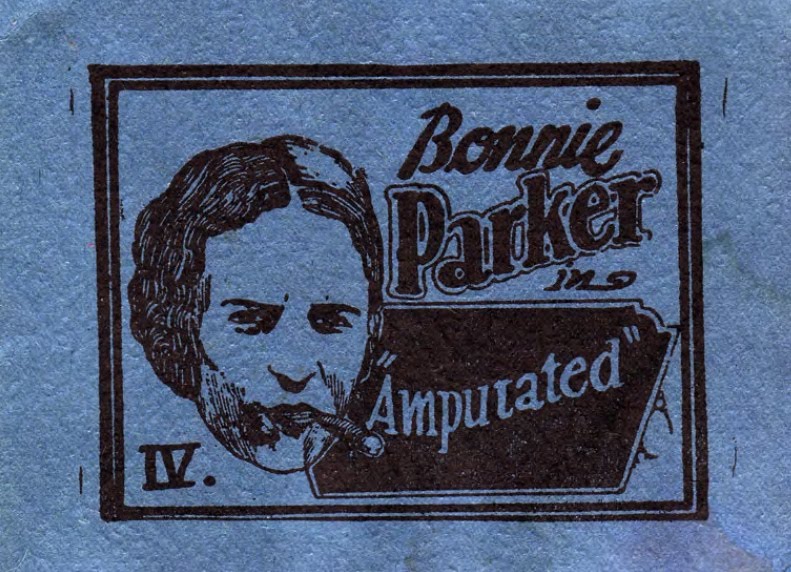
"Amputated"-- Could a Sordid 1930's Comic, Be the Source of Bonnie Parker Rumor??

2010 has been a good year for Bonnie & Clyde revelations. To me, it's felt like Christmas many times this year. And just as I was about to reveal perhaps the most important 2010 B&C revelations to date, I open a seemingly innocent e-mail. I receive many e-mails regarding B&C, but this one captured my attention to the point-- I wanted to offer a post and comment concerning this subject right away. I've chosen to save much time here, by posting some useful links which delve into the fascinating and seedy world of Tijuana Bibles.

http://en.wikipedia.org/wiki/Tijuana_bible
http://www.tijuanabible.org
http://www.tijuanabibles.org

These anonymously drawn and sexually explicit short comic expressions, were apparently underground favorites for decades-- including the depression riddled years of the 1930's. These no holds barred erotic comics, not only provided spoofs of many existing comic strip characters-- but sometimes parodied true life individuals as well. It seems movie stars and other famous people, were fair game to be exploited as subject matter for Tijuana Bibles. Dillinger had one-- so did Cary Grant and Dorothy Lamour. Clark Gable, William Powell & Mirna Loy, Esther Williams, George Raft, Gracie Allen and Robert Mitchum-- were also targets of these sordid expressions. Even the affable Robert Young, had a Tijuana Bible title. This brings us to our topic for this post.

It's been made known to me, that a Tijuana Bible exists for Bonnie Parker. The cover art for this old time comic, has been cataloged along with other B&C media pieces-- however it's likely rare, to find an intact "adulterated" version of this B&C relic. This undated 8 page glimpse into racy 1930's consciousness-- is titled "Amputated". A PDF of this recently obtained original Tijuana Bible was e-mailed to me, along with the educational links posted.

B&C forums all have their own standards for content and discussion-- as I have standards here. Based on the raw explicitness of this comic material and out of respect for the Parker family-- I've chosen not to provide an open link to "Amputated" within The B&CHB. However as I support full disclosure concerning B&C materials, I will provide a copy of this Bonnie Parker Tijuana Bible in PDF form-- to all who e-mail me requesting one. And to be fair, a disclaimer is also provided. **Please note-- the content of this Tijuana Bible portrayal of Bonnie Parker is blatantly sexual and explicit. Some may be offended by it's content or depiction of Bonnie-- but all will be enlightened, concerning the survival of this historically relevant parody. There-- now with that behind us, I make these observations.


As I've often made a point to discuss B&C sexual rumor and innuendo-- in viewing this fascinating BP Tijuana Bible, I wonder where the openly torrid "Amputated" fits within existing rumors concerning Bonnie Parker promiscuity?? With this is mind, an intriguing question can be asked-- could a sordid 1930's comic, actually "be" the source of Bonnie Parker sexual rumor?? It's seems obvious, that "Amputated" clearly spells out the inference that Bonnie has trouble being satisfied sexually. Thus a link could be made between this spoof of Bonnie, and the rumors advanced over the years-- concerning her sexual appetite. To some, "Amputated" could be viewed as a damning reflection on Bonnie, but in real terms-- this 8 page piece of old style smut, may serve best to reveal itself, as perhaps the source of decades of rumor. So which came 1st, rumors to inspire "Amputated"-- or the underground comic itself??

After 76 years, there doesn't seem to be verifiable evidence to support claims of Bonnie being a loose woman. Maybe for some in today's reality driven world, where truth is often contrived-- these B&C rumors are convincing enough to count as fact. But the "facts" as I see them concerning B&C sexual rumors, are such that no empirical evidence seems available-- to support these innuendos which so many may wish to be true, but have not been substantiated.
You would think if facts could be shown to demonstrate these realities, someone would have made the case by now. Instead as if by osmosis, these rumors just seem to seep into our collective consciousness from sources unknown. There are clues (or maybe not)-- within obscure references which live within literary expressions and seedy cartoons. But I would ask-- where is the proof, the smoking gun-- the 1st hand testimony to back these B&C rumors which are professed?? It's truly not good enough, for these rumors to be touted as "reality"-- without any discernible source!!

I don't have a hard time believing that people in the past, would have been crass enough to spread these rumors-- without evidence to back them up. But I do have a hard time believing, that if there really was something to B&C sexual innuendo, that some evidence wouldn't have surfaced by now. Perhaps the opposite is indeed the reality-- no sources-- no truth-- just playful/hurtful rumor, created by a free and loose press, some crime rag, an underground cartoonist-- or a B&C author just to be sensational. But that never happens does it?? The true untold stories of Bonnie and Clyde, are always told straight up aren't they??


It's strange enough concerning these rumors of Bonnie promiscuity. But what about the rumor of Clyde being homosexual. Where is the proof for that assertion as well?? You would think that an author with the credentials of a John Toland, would diligently verify his sources for any info he used-- including rumors?? The fact that a Pulitzer Prize winner, didn't or couldn't defend innuendos he decided to include within his only book on the criminal element of the '30's-- may speak volumes, concerning these stories perhaps just being rumors. Toland's book The Dillinger Days along with it's B&C references, was published in 1963-- long after any notion of politeness or sugar coating would need to be employed. Where are the footnotes??-- where are the facts for these assertions??

Perhaps Toland was a closet fan of Tijuana Bible humor??-- or just ran with stories passed down from others who were?? Could a dash of Tijuana Bible "shock value"-- together with a pinch of sensationalized fodder, combine to form the recipe for 3/4's of a century of scurrilous rumor?? Is that what this is really all about?? Or perhaps there's something to all this scuttlebutt?? Were earlier literary references, passed down without regard for the truth-- or is the truth still unknown?? I"m still asking where is the evidence??-- which for these self perpetuating rumors, seems not to exist.


Many like to hang their hats on the gossip within this history, without caring to examine what is actually known. Yes the gossip is known too-- but should innuendo carry equal weight, as accounts documented from credible sources?? That's the nature of evidence vs hearsay. Some people seem to relish hearsay concerning B&C, and bandy it about-- as if excited over some new phone app. A fair question to ask of these individuals might be-- would "they" want hearsay to be the standard applied in court-- should they become involved in some issue where the truth needs to be known?? The B&C families would likely and unanimously support B&C-- which is understandable. But surely with enemies having been out there, if evidence "was" available to support nefarious activities for B&C-- doesn't anyone feel some real evidence would be known??

I wonder why there's not a Tijuana Bible for Clyde being gay, if that was so believed back in the day-- like the one for Cary Grant?? Wouldn't a Clyde Barrow homosexual rumor, have made for a spectacular and juicy underground Tijuana Bible?!? I would bet so. I don't know-- all of these rumors just seem perpetuated without any real source, as if by smoke & mirrors. So does that make these rumors less relevant??-- or should we be digging to discover the truth regarding these sexual innuendos as well?? Perhaps "Amputated" is the answer to this Bonnie Parker mystery?? It's hard to know for sure, but I guarantee you one thing-- with this post up, those interested in B&C sexual rumors will flock here. "Yea Baby"!! But even though this topic needs to be addressed, as I've asked before-- sex sells, but at what cost to B&C History??? My approach is to go right at these fascinations-- to make people think-- and question what standards of truth should be applied to this history?? I welcome your comments.

Monday, June 14, 2010

Bonnie and Clyde Q&A-- Does a Photograph of Bonnie Parker and Frank Hamer Exist??

To my knowledge, the only image which could be made of Bonnie Parker along with Frank Hamer in the same phpto, would be a still created from Ted Hinton's film shot after the ambush. In some of this footage, Hamer can be seen watching as Henderson Jordan scours through B&C belongings from the death car. Of course within these moving images, B&C can be seen dead within the Warren car. It would likely take a review of all the Hinton footage, to see if a good photo of Hamer & Bonnie together would be possible. If you proceed to Hinton's footage blog right>> I recall there's a scene with Hamer visible, where the camera pans away from B&C to view Jordan and Hamer behind them. I believe that scene could be freeze framed to include both Hamer and Bonnie.

Frank Hamer is not known to have ever seen Bonnie Parker or Clyde Barrow, prior to the ambush. There do exist photos shot from the doorway of Congers, with Hamer visible at Bonnie's door seemingly made before the bodies were removed. However in both a crowd ladened photo with the crowds packed tight around him, and also within a shot made once a path had been cleared to the car-- no view is offered into the vehicle. I believe there are at least 2 more photos shot from this vantage point, where Hamer is positioned in the street on Clyde's side of the vehicle or elevated on the driver's side running board-- to perhaps address the crowd or gain order. People's idea that a photo of Bonnie and Captain Hamer exists, I suppose comes from the 1967 movie-- where the scene depicting a captured Frank Hamer was invented for the film. A number of lawsuits were won by surviving members of both the outlaw's and lawman's families-- based on inaccurate depictions of the real life individuals.

Saturday, June 12, 2010

A Bonnie Pregnancy??-- Oh Not That!!

This is one B&C subject where lines can be drawn with permanent markers, relationships can be strained-- and where comments run the gamut from being prolific, to being so quiet ssshhhh-- that you can almost hear a pin drop.

Images from inglorious uncaring bastards to celebrated heroes-- poor souls to those who deserved to die and couldn't die fast enough, fill the minds of B&C enthusiasts-- and those are just the usual debates. Then add the possibility of an unborn child to the mix, and well-- welcome to the great debate. The ambush, always seems to inspire the most interest of all B&C topics. But among Bonnie & Clyde wonderings, the thought of a pregnancy for Bonnie Parker??-- perhaps reaches the greatest depth, within the B&C well of emotion.